
Are you a 9th class student of Punjab Board and worried about English to Urdu translations in the 2026 exams? If yes, then you’re asking the right question at the right time. Every year, Punjab Boards repeat specific paragraphs from the textbook, and students who prepare them smartly secure easy marks.
This updated article is specially prepared for ALL Punjab Boards including Lahore, Gujranwala, Faisalabad, Multan, Rawalpindi, Sargodha, Bahawalpur, DG Khan, and Sahiwal. Since the English textbook is the same, the important translations are also the same for every board.
Why English to Urdu Translations Matter So Much?
English to Urdu translation questions are considered scoring because:
- Paragraphs are taken directly from the textbook
- The same ideas and lines are repeated every year
- Even average students can score full marks with selective preparation
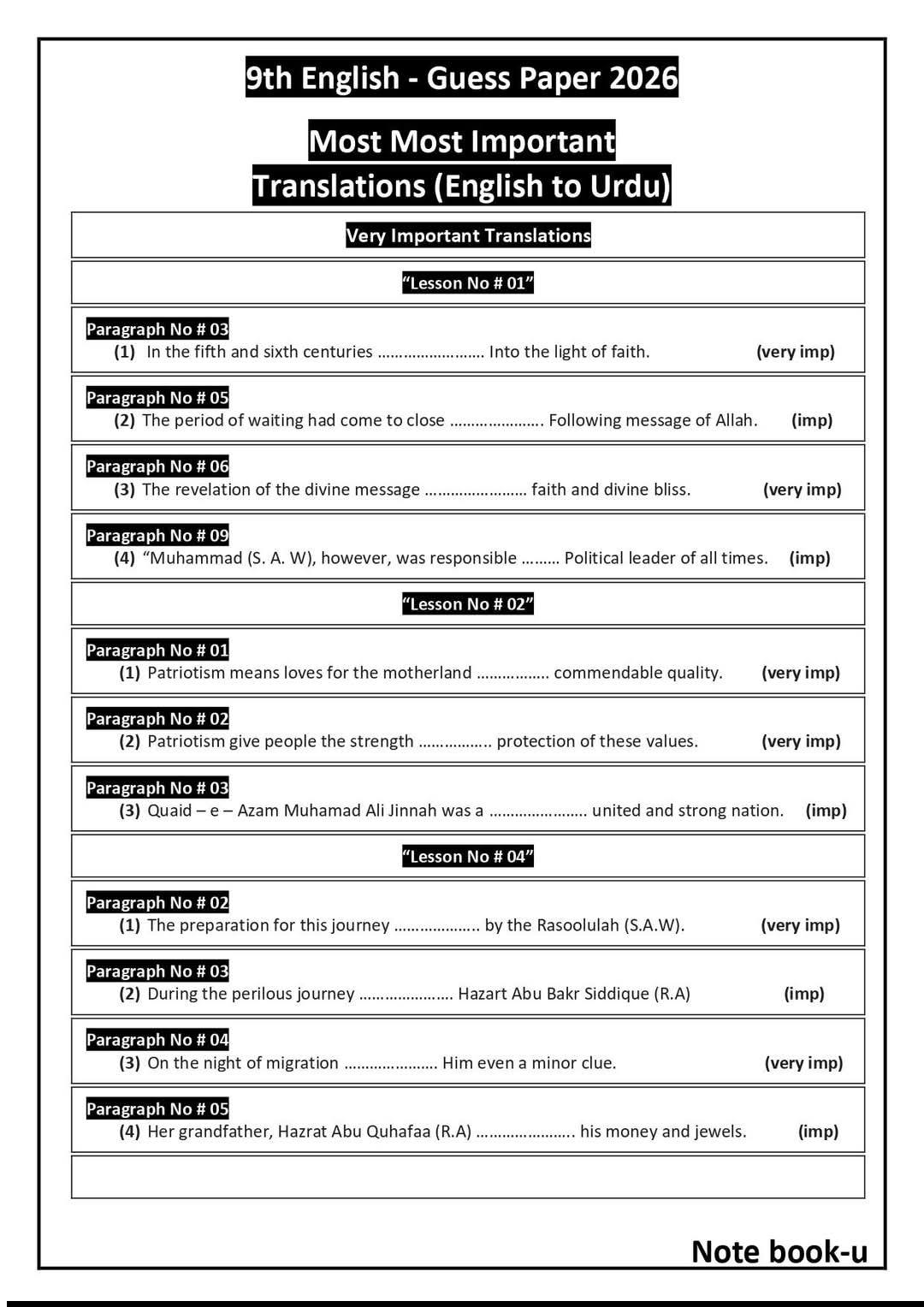
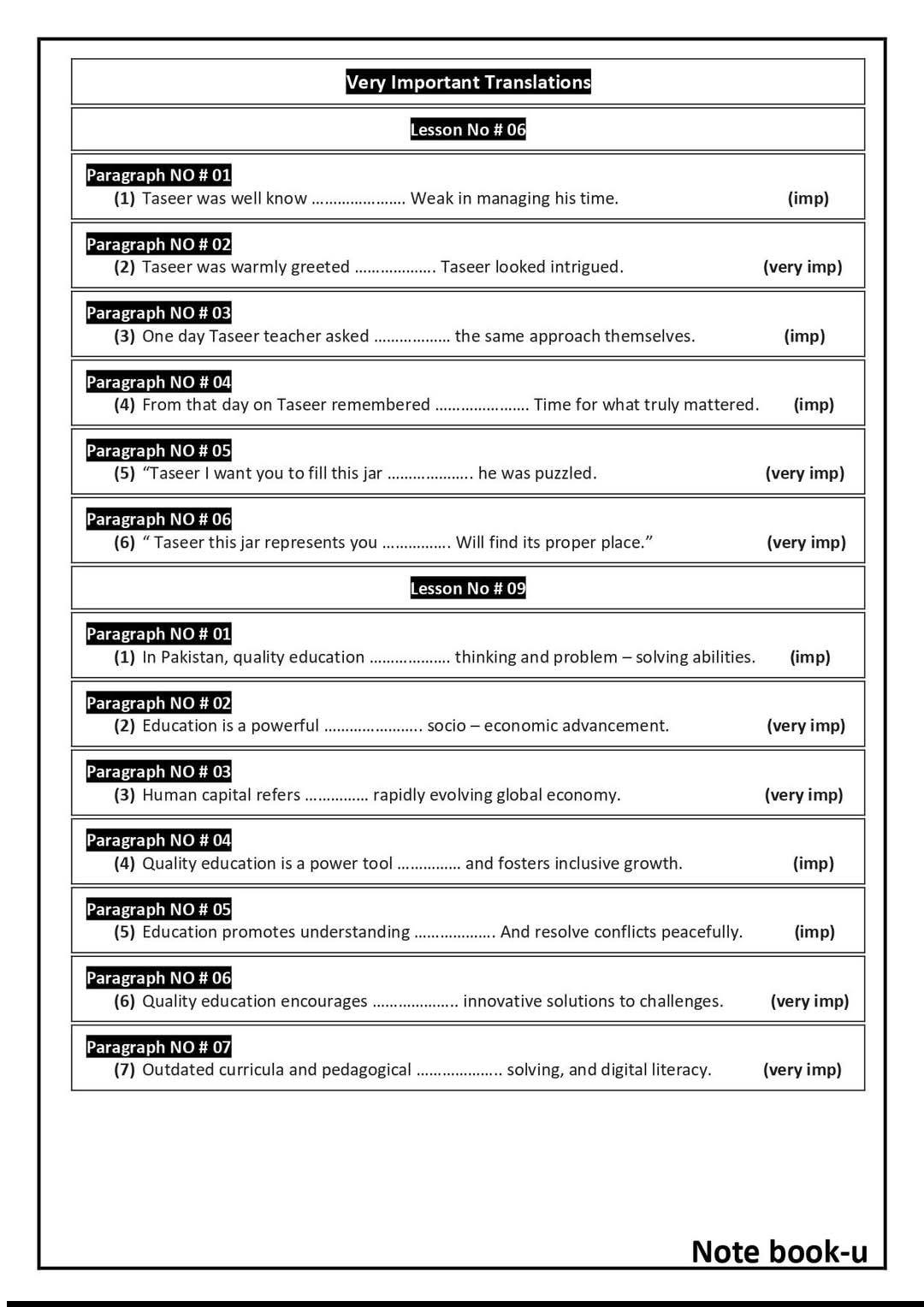
According to recent Punjab Board exam trends (2024–2025), most translation questions came from Lesson 06 and Lesson 09, making them extremely important for 2026 exams.
Lesson No 06 – Time Management (Taseer)
This lesson is among the most repeated lessons in translation questions.
Important Paragraphs with First & Last Wording
Paragraph 01
- First line: “Taseer was well known for his intelligence but he was weak in managing his time.”
- Last line: “He was weak in managing his time.”
Paragraph 02
- First line: “Taseer was warmly greeted by his teacher when he entered the classroom.”
- Last line: “Taseer looked intrigued.”
Paragraph 05 (Very Important)
- First line: “Taseer, I want you to fill this jar,” said the teacher.
- Last line: “He was puzzled.”
Paragraph 06 (Very Important)
- First line: “Taseer, this jar represents your life,” the teacher explained.
- Last line: “Everything will find its proper place.”
👉 Expert Tip: Examiners love this lesson because it contains moral, concept-based ideas. Learn these paragraphs with simple Urdu, not difficult words.
Lesson No 09 – Education & Human Capital (Most Important for 2026)
This lesson matches modern education themes, so it is highly expected in upcoming exams.
Important Paragraphs with First & Last Wording
Paragraph 01
- First line: “In Pakistan, quality education plays a vital role in national development.”
- Last line: “It enhances critical thinking and problem-solving abilities.”
Paragraph 02 (Very Important)
- First line: “Education is a powerful tool for personal and national growth.”
- Last line: “It leads to socio-economic advancement.”
Paragraph 03 (Very Important)
- First line: “Human capital refers to the skills, knowledge, and experience of people.”
- Last line: “It is essential in a rapidly evolving global economy.”
Paragraph 06 (Very Important)
- First line: “Quality education encourages creativity and innovation.”
- Last line: “It enables innovative solutions to challenges.”
How to Prepare Translations for Punjab Board Exams
Step 1: Focus on Selective Paragraphs
Don’t translate the whole book. Prepare only important paragraphs.
Step 2: Learn First & Last Lines
If you remember the starting and ending lines, you can instantly recognize the paragraph in the exam.
Step 3: Use Simple Urdu
Punjab Board examiners prefer:
- Easy vocabulary
- Clear meanings
- Concept-based translation
Step 4: Daily Writing Practice
Write at least one translation daily to improve speed and accuracy.
Common Mistakes to Avoid
❌ Word-by-word translation
❌ Using very difficult Urdu
❌ Ignoring lesson-wise importance
❌ No writing practice
Also Read About: Math 9th Class Smart Syllabus 2026
Avoiding these mistakes can significantly increase your marks.
Why This Guess Paper Is Reliable for 2026?
✔ Based on Punjab Board paper patterns
✔ Covers repeated exam paragraphs
✔ Updated according to latest syllabus
✔ Trusted by teachers and toppers
Final Words
If you want to score high in 9th class English 2026, smart preparation is the key. These most important English to Urdu translations, along with first and last wording, give you a clear exam advantage across all Punjab Boards.
📌 Prepare smart, revise regularly, and walk into the exam with confidence.