
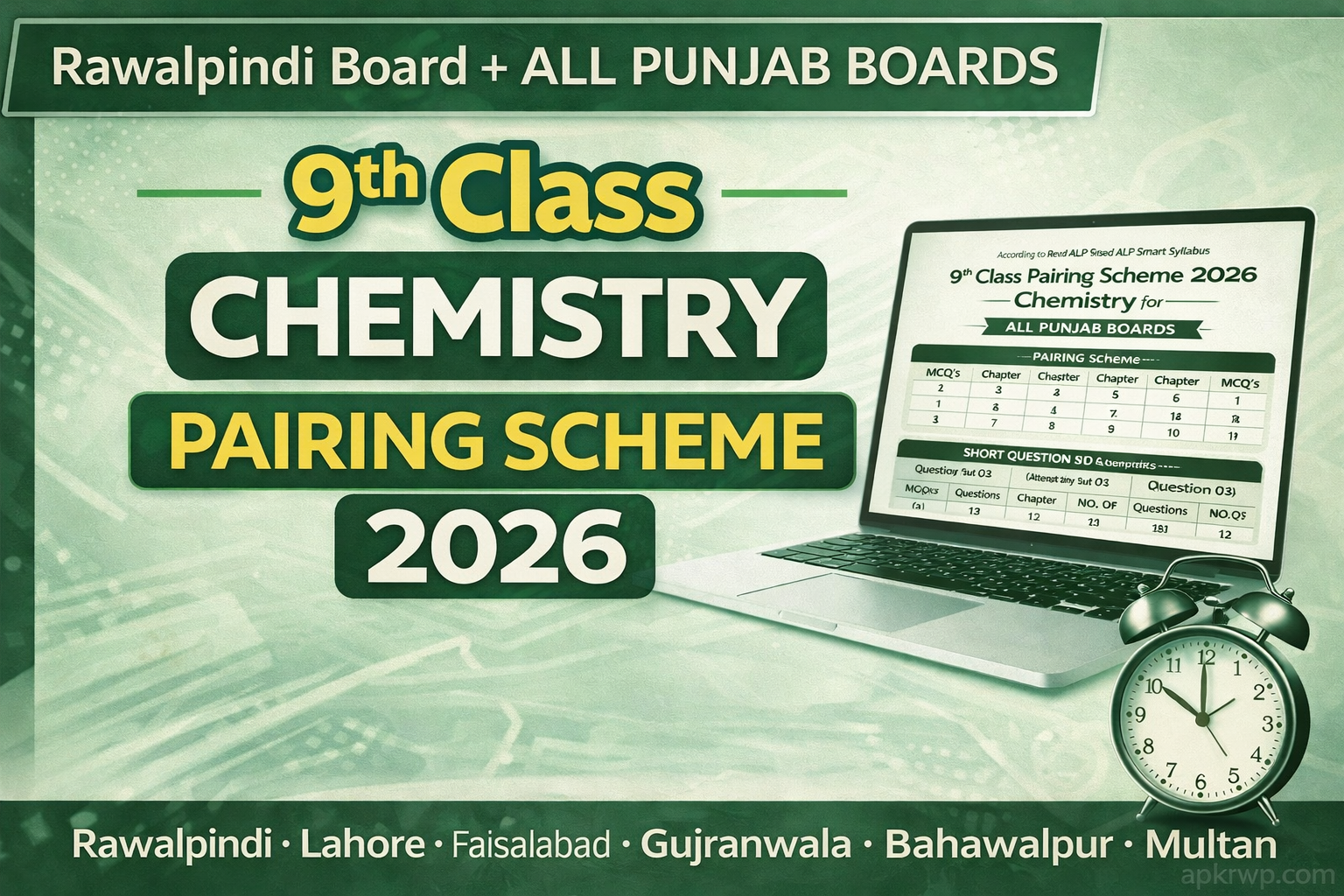
Are you confused about which Chemistry chapters matter most in the 9th class exams 2026? If you’re studying under the Rawalpindi Board or any Punjab board, understanding the 9th class Chemistry pairing scheme 2026 can save time, reduce stress, and significantly improve your exam preparation.
This updated pairing scheme follows the Revised ALP Smart Syllabus and clearly explains how marks are distributed across MCQs, short questions, and long questions.
What Is the 9th Class Chemistry Pairing Scheme?
The Chemistry pairing scheme is a chapter-wise breakdown of the exam paper. It helps students understand:
- From which chapters questions are asked
- How many marks each section carries
- How questions are paired in long answers
Instead of studying the entire syllabus randomly, students can prepare strategically and smartly using this scheme.
Chemistry Paper Pattern for 9th Class 2026
According to the latest available structure, the Chemistry paper is divided into three main sections.
MCQs Section (12 Marks)
The MCQs section consists of 12 multiple-choice questions, each carrying 1 mark. These MCQs are selected from almost the entire syllabus, meaning every chapter is important at a basic level.
This section mainly tests:
- Definitions and key terms
- Chemical formulas
- Conceptual understanding
- Short factual knowledge
Students are advised to revise book lines, tables, and basic concepts to score full marks here.
Short Questions Section (30 Marks)
In the short questions section, students must attempt 5 questions out of 8. Each question includes multiple parts and is designed to test concept clarity.
The pairing scheme shows that:
- Early chapters contribute foundational concepts
- Middle chapters focus on chemical reactions and reasoning
- Later chapters test application-based understanding
This section requires:
- Clear explanations
- Correct chemical equations
- Neat and structured answers
Practicing textbook questions is essential to perform well in this part.
Long Questions Section (Attempt Any 2)
The long questions section allows students to attempt any 2 questions. Each long question is divided into two parts (a & b) and is paired from selected chapters.
Long questions usually focus on:
- Detailed explanations
- Step-by-step reasoning
- Proper use of chemical terminology
Because questions are paired, students can prepare selected chapters thoroughly and still have choice in the exam.
Chapter Importance Strategy
While MCQs cover the full syllabus, the pairing scheme indicates that:
- Some chapters appear repeatedly in short and long questions
- Certain chapters are more suitable for long answers
- Skipping chapters is risky, but priority-based preparation is effective
Also Read About: Chemistry 10th Class Pairing Scheme 2026
Students should aim to:
- Cover all chapters for MCQs
- Focus more on high-weight chapters for short and long questions
How to Prepare Chemistry Using the Pairing Scheme
Here are some practical, exam-focused tips:
- Memorize definitions, formulas, and reactions for MCQs
- Practice short questions with clear headings and steps
- Prepare long questions with proper explanations and diagrams
- Revise important chapters multiple times instead of rushing the syllabus
- Stick to Punjab Textbook Board content only
This approach helps improve confidence and time management during exams.
Is This Scheme Valid for All Punjab Boards?
Yes. The 9th class Chemistry pairing scheme 2026 applies to Rawalpindi Board and all Punjab boards, as the syllabus and exam structure are uniform across the province.

However, students should always follow official board notifications for final confirmation.
Final Words:
The 9th class Chemistry pairing scheme 2026 is a powerful guide for students who want to prepare efficiently and score better without unnecessary pressure. By understanding the paper pattern and focusing on the right chapters, students can turn Chemistry into a scoring subject.